
Dynamics GP End of Life Canada
What Canadian Businesses & Municipalities Must Know Before 2029
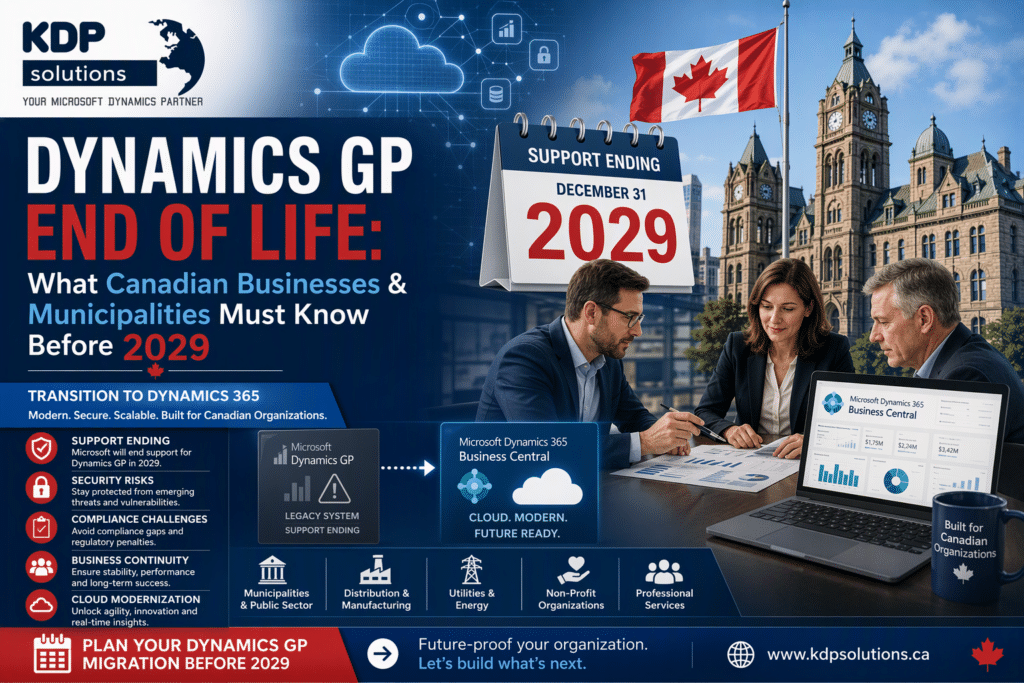
Microsoft Dynamics GP will reach its End of Life on December 31, 2029. For Canadian organizations still running GP, this means you have a limited window to migrate to a modern, cloud-based ERP like Microsoft Dynamics 365 Business Central to avoid security risks, compliance failures, and operational disruptions.
The 2029 deadline may sound distant, but a successful ERP migration requires significant planning, data cleanup, and execution time. For many Canadian municipalities and corporations, the math is already uncomfortable. in this article Dynamics GP End of Life Canada… we will walk you through some helpful tips
Quick Answer
Microsoft Dynamics GP will reach end of life on December 31, 2029. Canadian businesses, municipalities, and public sector organizations should begin planning their migration to Microsoft Dynamics 365 Business Central now to maintain payroll compliance, regulatory reporting, cybersecurity protection, and long-term operational support.
The Dynamics GP End of Life Timeline: The Critical Dates
Microsoft has confirmed the following key dates for Dynamics GP support:
| Milestone | Date | What It Means |
|---|---|---|
| New subscription sales end | April 1, 2026 | No new customers can adopt GP in any form. |
| Mainstream support ends | December 31, 2029 | No more feature updates, regulatory/tax updates, service packs, or technical support. |
| Final major update (expected) | October 2028 | The last significant functional update for GP. |
| Security updates end | April 30, 2031 | Even critical security patches stop. Your system becomes fully unsupported. |
The date that should anchor your planning is December 31, 2029—not 2031. After that date, you stop receiving regulatory and tax updates entirely. For a system whose job is compliant financial reporting and accurate tax handling, that is the real deadline.
Why This Is Especially Urgent for Canadian Organizations
Dynamics GP currently provides Canadian payroll tax updates for T4, RL-1, and CRA remittance changes. After December 31, 2029, no further payroll tax table updates will be provided. The final year-end/payroll tax update is expected for December 31, 2028.
Running unsupported payroll software puts your organization at risk of:
Incorrect CPP, EI, and QPP deductions
Non-compliant T4 and RL-1 slips
CRA remittance errors
Audit exposure and penalties
For Canadian municipalities, this risk is amplified. Over 250 Canadian municipalities rely on Dynamics GP (often with Diamond Municipal Solutions or Central Square), and many depend on the Microsoft Canadian Payroll module built into GP
Municipalities Face a Unique Challenge
Canadian municipalities using Dynamics GP face compounding pressures:
PSAB compliance risk: Public Sector Accounting Board standards require accurate, auditable financial reporting. Unsupported software increases audit and compliance exposure.
Capacity constraints: With hundreds of municipalities and thousands of corporations all facing the same 2029 deadline, implementation partners are already in high demand. Municipal migrations typically take 9–18+ months; corporate migrations take 4–12+ months depending on size and complexity.
Escalating costs: Delaying replacement means competing for scarce implementation resources at the last minute, driving up costs and risk.
Data Residency and Privacy
Canadian organizations—especially those in the public sector—must consider data sovereignty. Microsoft Dynamics 365 Business Central runs on Azure with Canadian data centres in Toronto and Québec City, enabling Canada-only data residency that supports PIPEDA compliance. This is a significant advantage over on-premises GP infrastructure, which requires your own server room, maintenance, and security
Your Migration Path: Why Dynamics 365 Business Central Is the Recommended Choice
Microsoft Canada is explicitly recommending that all Dynamics GP users migrate to Microsoft Dynamics 365 Business Central (SaaS Cloud ERP) .
Built-in migration tools allow you to move data directly from Dynamics GP 2015 and later versions to Business Central online.
Key Benefits for Canadian Organizations
| Benefit | Why It Matters |
|---|---|
| Cloud-based | No server maintenance, automatic updates, built-in disaster recovery. |
| Canadian data residency | Data stored in Azure Toronto and Québec City data centres. |
| Native Canadian tax support | GST, PST, QST, and French Canadian language support run out of the box. |
| Microsoft 365 integration | Seamless connection with Teams, Outlook, and Power BI. |
| Multi-entity consolidation | Ideal for organizations operating across multiple Canadian provinces or internationally. |
| Certified Canadian payroll integrations | Connect with ADP Workforce Now, Ceridian Dayforce and other leading providers. |
Canadian Payroll Integrations for Business Central
Business Central does not include native Canadian payroll, but it integrates seamlessly with leading providers to deliver full compliance:
ADP Workforce Now: Canada’s largest payroll provider. Handles multi-province payroll, ROEs, direct deposit, T4s, and tax remittances with real-time GL sync.
Ceridian Dayforce: Cloud HCM + payroll platform. Automates complex Canadian tax calculations, year-end reporting, and benefits. Strong for mid-market to enterprise.
Payworks: Canadian-built solution ideal for SMBs. Manages payroll, time & attendance, and HR with direct integration.
Rise (by Paychex) : Affordable cloud payroll for smaller businesses, covering all provinces with automated deductions
How to Prepare for Your Canadian Migration: Actionable Steps
1. Assess Your Current GP Environment
Before any migration decision, conduct a thorough audit of your GP setup:
Identify active modules, add-ons, and integrations
Document customizations and workflows
Review historical data volume and cleanup needs
Confirm your GP version (2015 or later is required for built-in migration tools)
2. Choose a Certified Canadian Microsoft Partner
Work with a partner who understands Canadian payroll, tax compliance, and public sector requirements. Your partner should have experience with:
GP-to-Business Central migrations
Canadian payroll integrations
Municipal and public sector ERP deployments
3. Plan Your Migration Timeline
Work backwards from the 2029 deadline. A well-run migration typically takes:
Corporate migrations: 4–12+ months depending on size and complexity
Municipal migrations: 9–18+ months due to governance, procurement, and stakeholder requirements
Complex, multi-entity organizations: 12–18+ months
You need 12–18 months of runway to do this properly—not the final six months before support ends.
4. Prioritize Data Cleanup
Not everything in your GP environment should migrate. Years of duplicates, inactive records, and inconsistent coding need a plan before go-live, not during it. Focus on:
Cleaning vendor and customer master data
Removing obsolete records
Standardizing account structures
Validating historical data for migration
5. Train Your Team Early
The technical build is rarely the hard part. Getting your team comfortable in Business Central before go-live is what separates a smooth transition from a painful one. Plan for:
Role-based training sessions
Sandbox testing with real scenarios
End-user acceptance testing before cutover
Post-go-live support and stabilization
The Cost of Waiting
Delay feels free. It isn’t.
Compliance risk compounds: Every payroll change, tax-rate revision, or reporting requirement after 2029 becomes a manual workaround or custom fix—each carrying risk of error.
Expertise becomes scarcer: Specialists who maintain aging on-premises GP systems become more expensive as the ecosystem shrinks.
Implementation capacity tightens: As the deadline approaches, every GP customer who waited will be competing for the same limited pool of qualified implementation partners.
Add Your Heading Text Here
The December 2029 deadline may seem far away, but a successful ERP migration requires significant planning, execution, and organizational change management. Canadian municipalities, in particular, face procurement timelines and governance requirements that can add months to any project.
Contact KDP Solutions for a free Canadian Dynamics GP migration assessment. We’ll help you evaluate your current environment, map a migration path to Dynamics 365 Business Central, and build a timeline that protects your compliance, your data, and your operations—well before the 2029 deadline arrives.
KDP Solutions is a Canadian Microsoft partner specializing in Dynamics 365 Business Central implementations, Canadian payroll integrations, and GP-to-BC migrations for businesses and public sector organizations.
FAQ
For frequently asked questions about Dynamics 365 Business Central Edmonton, feel free to reach out to us.
A1: Microsoft Dynamics GP mainstream support ends on December 31, 2029. After that date, organizations will no longer receive feature updates, payroll updates, tax updates, service packs, or technical support. Security updates are expected to end on April 30, 2031
A2: Canadian organizations depend on current tax, payroll, and regulatory updates to remain compliant. After 2029, unsupported systems may increase risks related to CRA remittances, T4 reporting, payroll deductions, audit requirements, cybersecurity, and financial reporting compliance.
A3: Microsoft recommends Dynamics 365 Business Central as the strategic replacement for Dynamics GP. Business Central is Microsoft’s cloud ERP platform and includes integrated financial management, reporting, inventory, purchasing, project management, and Microsoft 365 connectivity.
A4: Yes. Microsoft provides migration tools that allow organizations running Dynamics GP 2015 or later versions to migrate financial and operational data to Dynamics 365 Business Central online. Additional migration methods are available for customized environments.
A5: Business Central integrates with leading Canadian payroll providers, including ADP Workforce Now, Dayforce, Payworks, and Rise. These solutions support Canadian payroll processing, tax remittances, T4 reporting, direct deposit, and provincial payroll requirements.
A6: Municipalities face additional procurement, governance, cybersecurity, and PSAB reporting requirements. Longer approval cycles, stakeholder reviews, and compliance obligations often extend ERP modernization projects significantly beyond those of private-sector organizations.
A7: KDP Solutions helps Canadian businesses, municipalities, and not-for-profit organizations assess their Dynamics GP environment, plan migration strategies, migrate to Dynamics 365 Business Central, integrate Canadian payroll solutions, train users, and provide ongoing support.